
“Your Ideas. Our Tools.” If you’re familiar with HydroComp, you may recognize this tagline – it’s the way we work with designers, builders, and naval architects around the world. At the center of this collaboration is our flagship tool NavCad, our software for hydrodynamic and propulsion system simulation. It’s the tool marine professionals rely on when they need clarity and confidence.

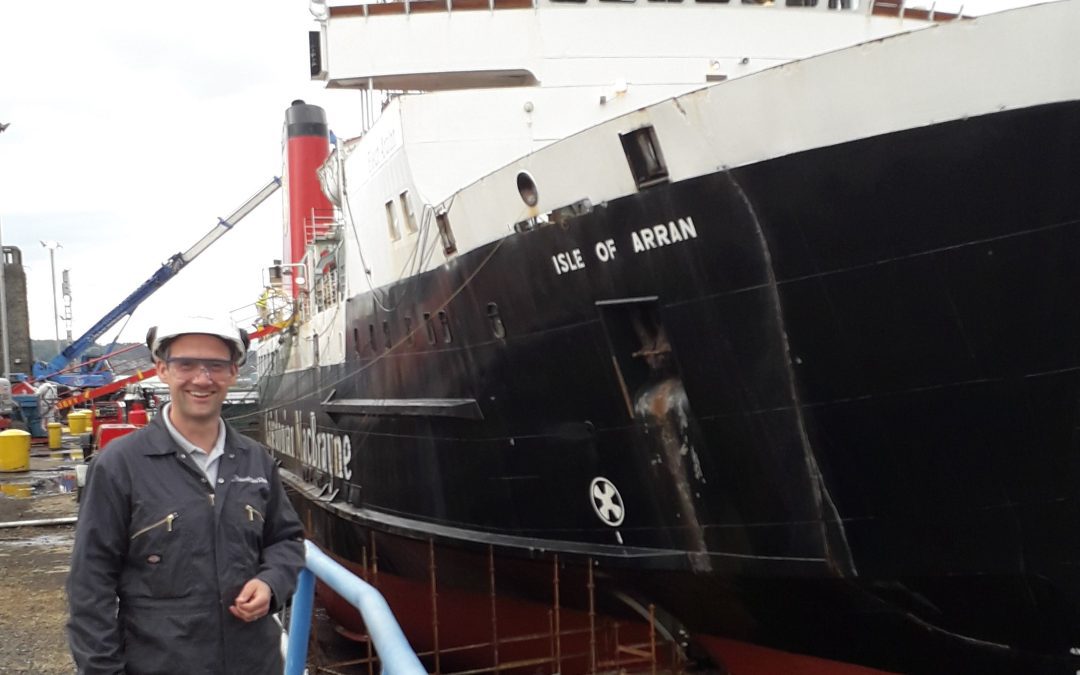
One of those professionals is Andrew Alexander, founder of Alexander Marine Design. We recently spoke with Andrew, a seasoned naval architect who champions NavCad. With decades of hands-on experience, Andrew appreciates the role that HydroComp software plays in his workflow – it’s something that he always has in his back pocket.
Andrew’s first introduction to NavCad was in 2010 at Offshore Ship Designers, whose focus was on the design of offshore vessels like platform supply vessels and anchor handlers. “As a consultancy, their main function was selling new ship designs. They were starting ship designs from zero and selling drawing packages to shipyards and to ship owners. That was when I first came across NavCad and used it a lot, almost every week. It was just a superb tool.”
After spending nearly 20 years in shipyard design offices such as Ferguson Shipbuilders and Harland & Wolff and in consultancy roles with firms like OSD, he found himself returning to the same thought: “I’d really like to be doing this myself.” Eight years ago, he finally made the jump to go out on his own and hasn’t looked back since. Founded in Scotland, Alexander Marine Design is the result of Andrew’s unwavering entrepreneurial spirit.
With his appreciation for NavCad already established, Andrew bought it the moment he launched his new business. “There were some new design contracts I was chasing, so I got NavCad right away to make sure I was set up for that.” While his work since has largely focused on modifications to existing ships, he has admittedly not used NavCad as much as he would have liked – but that’s about to change.
“I’ve actually just put a proposal in today for a new ferry design project,” he shares with excitement. “And a very big part of the project is to replace an existing ferry, but there’s a big focus on the propulsion arrangement. Could we do something more advanced and efficient with the propulsion installation; could we look at it being electric or hybrid? So a very big part of that project would be using NavCad to do the comparisons with propulsion and powering for the various options.” Lucky for Andrew, electric motor features have been added to NavCad, and he’s eager to dive into these recent developments. “I definitely hope that this project comes off. We’d be using NavCad quite intensively for about 6 months.”
Why is NavCad so special to Andrew, even if he hasn’t been using it recently? It gets back to the basics of naval architecture and it’s trustworthy.
“When it comes to structural design, young engineers want to go straight to 3D modeling and finite element analysis. They don’t believe anything unless it’s a full 3D model finite element result and actually have no concept of the real first principles. I’ve seen it lots of times, young engineers say, ‘Look!’ and they’re showing you the answer and they don’t have enough experience to know that’s just nonsense, that that’s not right; I don’t care what all these pretty pictures show,” he explains.
“But that’s what I like about NavCad. It’s not straight to fancy CFD or a full-blown model test. It’s actually built with the first principles. You can see what you were taught at university, the real theory, and you can control it and interact with it. You can trust it. I like to be able to understand what the software is doing and you build trust with it that way.”
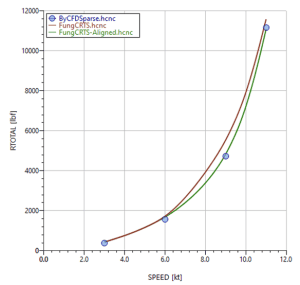
Andrew recalls starting his career alongside a naval architect who had developed his own DOS-based empirical powering prediction software. “It relied heavily on data from previous Sea Trial data from the ships the yard had already built – very similar to NavCad’s Aligned Prediction feature.”
To this day, Aligned Prediction remains one of Andrew’s favorite NavCad capabilities.
“If you’ve got a vessel that’s reasonably close to the new project you’re working on, Aligned Prediction gives you confidence in the results. That’s why I like NavCad so much at the start of a new design. You can jump straight in, understand what it’s doing, and trust what it’s telling you.
It’s right there on your desktop, and during concept design you can quickly explore ideas – ‘What if I try this?’ or ‘What if I try that?’ – and see the results immediately. With full CFD analysis, you’re committing to a significant expense and often relying on an external specialist. Once that process starts, making changes becomes difficult.
HydroComp’s Technical Director, Don MacPherson, notes, “Andrew’s use of NavCad’s Aligned Prediction feature is a real ‘knowledge multiplier’. It leverages existing prediction assets that a designer might have – both in terms of using specific ship performance from sources like model tests or sea trials as a reference, but also as a companion for how CFD is applied in a project. In the latter case, a user can employ what we call ‘sparse CFD’ that allows NavCad’s AP to fill in a full speed curve from just three or four computation speeds, thus making CFD more efficient and effective, especially if multiple CFD runs are anticipated for a broad design space.”
NavCad gives you the control and flexibility to keep experimenting. That’s always been one of its biggest strengths for me, and why I’m hoping to use it on the project we’re about to begin.” It builds on dozens of different prediction models while adding modern features, like analytical wave-drag methods or preparation of EEXI calculation documents, that make it even more useful. Don adds, “Many well-known prediction methods are included in NavCad. That said, not all of a method’s published algorithms represent its full potential or its limiting constraints. We go through an extensive multi-step validation process for each proposed new method, from communication with the method’s authors, to reference data input-output confirmation, and finally to broad validation against our extensive library of reference vessels to confirm the extent of a method’s acceptable scope. And some just do not pass. We also benefit from NavCad’s broad user community, like Andrew, that frequently provide additional knowledge about features to add or specific vessel parameters that require a deeper review.”
“The propeller analysis side is excellent as well,” states Andrew. “I’ve used it frequently because it gives you a solid understanding of what propeller is best suited for a particular vessel without the cost and time commitment of CFD. You’d spend a lot of money to get that same level of early-stage insight through testing.”
Beyond the software tool itself, Andrew says that Don is “the man.” “As well as you can trust the software, you can trust him. He’s always willing to answer my questions and help me out.”
For Andrew, NavCad is more than just software – it’s a trusted design partner that has been with him through shipyards, consultancies, and now his own firm. Whether evaluating propulsion options for a new ferry, comparing conventional and hybrid solutions, or exploring early-stage concepts, it provides the confidence, flexibility, and technical foundation needed to make informed decisions. That trust has been built over more than a decade of use, supported by software grounded in first principles and backed by a team that understands the challenges naval architects face. As Andrew embarks on his next vessel design project, NavCad remains exactly what it has always been: a tool that helps turn ideas into reality. After all, that’s what “Your Ideas. Our Tools.” is all about.
Download this story here.
For more information, contact:
HydroComp, Inc.
Tel +1.603.868.3344
danielle.doonan@hydrocompinc.com
hydrocompinc.com
 Copyright © , HydroComp Inc. | All Rights Reserved