
A conversation with Reagan Nielsen of Jensen Mixers
HydroComp has long been a familiar and trusted name in the marine world, but you might be surprised to discover our reach extends beyond the water – specifically through our work with Jensen Mixers. An Oklahoma family business founded 75 years ago, Jensen specializes in the manufacturing of side-entry tank mixers. These are used not in the ocean, but in large petroleum storage tanks. We spoke with Reagan Nielsen, Jensen Mixers Vice President of Operations, about how this successful collaboration with HydroComp came to be.

Back in 1950, Albert Jensen established Jensen Mixers. The concept for this company came out of a need from a petroleum company. “They had these lease tanks out in the middle of fields that they would be pumping into. Well, whenever they came to pump them down, they would be so full of junk that it was just horrible,” explains Reagan. And so, Jensen Mixers was born. It’s the only mixing company that started as a mixing company. “We make a unit that goes on the side of a large petroleum storage tank and its sole purpose is to keep the BS&W, basic sediment and water, in an agitated state.”
“Our relationship with HydroComp has been so long, roughly 16 years,” Reagan begins. “We like to evolve, but unfortunately, we move about as fast as molasses. I knew there was a need for a new propeller eventually. The unit we had was functional, but not the most current technology.”
Reagan connected with HydroComp Technical Director, Donald MacPherson, with a request for that long-needed new propeller design. Luckily for Reagan, this is Don’s bread and butter. “I didn’t realize exactly who Donald was when we were having the initial conversation,” reflects Reagan. “It was kind of one of those when you hang up the phone and you’re like, ‘Who was that?’ He went through an early iteration of PropCad and said, ‘Voila! Here’s your prop.’”
While Reagan and his team thought that the propeller looked great, they admittedly didn’t have the knowledge or technology to build it at that time. “The propeller is called the Phoenix because the project’s died so many times before birth to now,” he chuckles. “We’d pick it up and we’d kind of look at it, we’d do a little bit with it and then it wasn’t urgent, so it would kind of fall into the background of projects.”
When Reagan’s father passed away 12 years ago, he and his brother were reminded of his innovative plans. “Dad had always had a new design for a new unit on the drawing table. Old-school, you know, there’s no CAD; there’s a drafting table, there’s a slide rule, and there’s pencils,” Reagan reminisces. “He would love to draw all that stuff out and he always had this new design going on and when he passed away, my brother and I said, ‘All right, we’re going to do this. We’re going to figure this out, we’re going to build this.’” The Nielsen Brothers were determined to upgrade their product with the best technology.
When they revisited their design with the HydroComp team, Reagan said, “Okay here’s our largest problem: you’re used to water. We don’t do water.” Given HydroComp’s clientele of naval architects and marine engineers, water is naturally the first assumption. “I said, ‘We’re in crude and gasoline. We’ve got viscosities between four and 4,000 that we deal with.’ Don’s reply was, ‘Well… That’s new. I’ve never done anything like that before.’” HydroComp’s Technical Director is never one to back down from a challenge. Reagan says that seeing the wheels turning in Don’s brain was “like listening to a kid on Christmas, like we were giving him a new toy to play with.”
Reagan outlined his goals, which included a propeller sizing program. ” We have a set volume of fluid to move, specific fluid characteristics to consider, and a clear objective. Whether it’s transferring a precise amount within a given timeframe or ensuring enough momentum for the fluid to travel across the tank, the goal remains the same – creating a dynamic flow that effectively sweeps and swooshes back and forth to clean the bottom,” he explains. “Water has a fixed specific gravity and viscosity, it’s a known object. So now we have new viscosities and specific gravities. When you’re turning in a viscosity of 0.7, you have this much slip to deal with, this much inertia, and this much resistance. Move that to 0.9 and you have a new specific gravity on your hands. It’s a whole new ball game.”
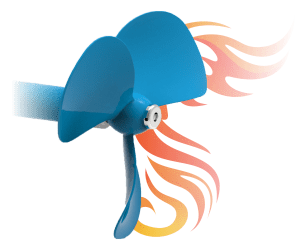
The “Phoenix Propeller” HydroComp designed for Jensen Mixers.
They started building the blades with the help of a company in Texas, but the first model wasn’t perfect. With various factors to consider, including different geometries, this was not a one-and-done exercise. This started an almost 2-year conversation with HydroComp. “We’ve got a 50-foot-diameter, 25-foot-tall water tank in our front yard. So we can actually take a prop, send it down, put it on. We can get thrust numbers and vibration numbers. We started giving that data back and forth over the last two years to Donald. He’s been using the real-world water data and is able to extrapolate that into the crude data and then started building us this predictive sizing tool. The challenge that we presented to HydroComp, they bit on with both teeth and said, ‘All right, we’re going to figure this all out.’”
As the team at Jensen Mixers began to more closely review the blades that they had received from their manufacturer, they found differences in the heights of the edges of the blades. It became apparent they would also need tools to Q/A and make adjustments to the propeller blades during the assembly process.
Don referred Reagan to TrueProp Software, who provides propeller inspection tools for the marine industry and also shares a long history with HydroComp! They then began to discuss the implications of manufacturing tolerances on performance.
With their newfound need for propeller measuring equipment and an upcoming deadline to deliver units for 2025, TrueProp connected them with Gary Linden of Linden Propeller – he is an OEM supplier of the Linden DDS and Linden Scan Versa pitchometers, which are purpose-built to run TrueProp Software.
“We discovered that a class 3 propeller on a 29-inch diameter or larger is not good enough for our application. We actually have to be almost a class 2,” Reagan shares. “We’re working with Adam right now to try and get a little custom programming, so we’ve got a 2A and a 2B that’s going to sit between that group 2 and that group 3 design.”

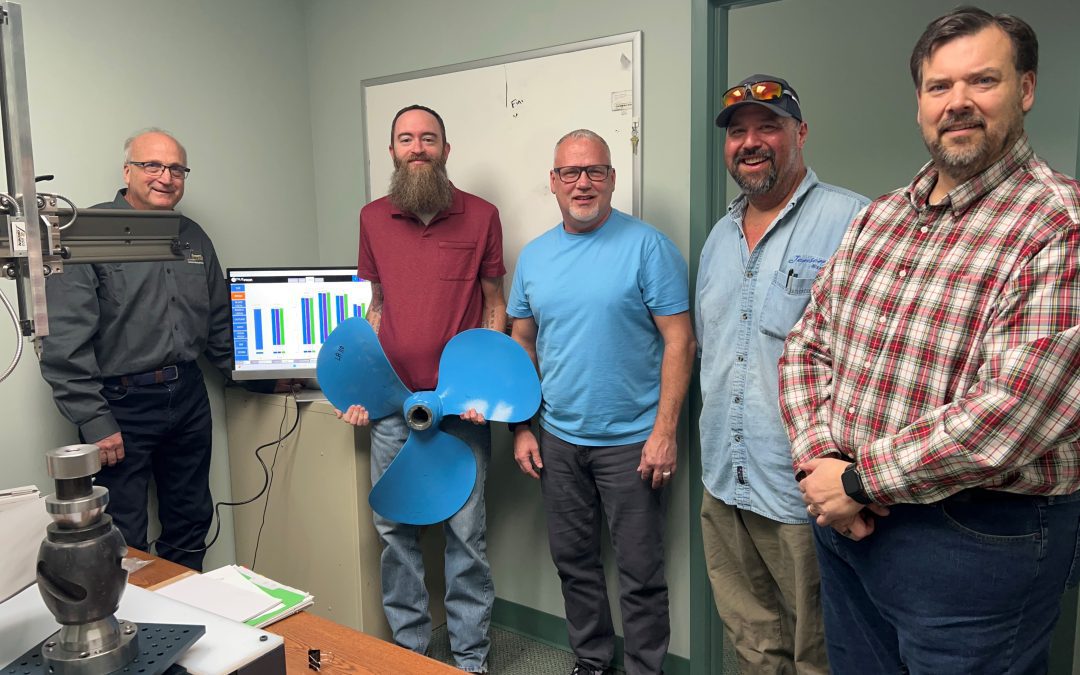
Gary Linden (Linden Propeller), Trevor Eames, Travis McClain, Bill King, and Reagan Nielsen (Jensen Mixers), with the specially-engineered propeller.
He’s proud that after years of development and testing, Jensen Mixers is able to improve upon their original model with a new propeller. “I do know that because of Don and HydroComp, we are far smarter today in the nuances and the capacity of what current propeller design is than we were 20 years ago. It’s been a collaboration that’s been years in the making that only today is showing the fruit of what we had started 20 years ago. It’s been ages, but we now have a Phoenix – it’s got its own logo.”
Most of all, Reagan is deeply grateful for the connection he forged with Don, describing him as “an inspiration.” True to his nature, Don never hesitates to dive in—whether tackling complex technical challenges or mentoring those eager to learn. A teacher at heart, he thrives on sharing knowledge, transforming every opportunity into a lesson worth remembering.
This ongoing consulting project with Jensen Mixers presented a unique challenge – one that HydroComp eagerly embraced. Innovation and collaboration have always been at the core of HydroComp’s approach, and stepping into new territory only strengthens that commitment.
Will HydroComp be testing the waters in a new industry in the future? If history is any indication, the answer is yes. Stay tuned!
Download this interview here.
For more information, contact:
|
HydroComp, Inc. Tel +1.603.868.3344 danielle.doonan@hydrocompinc.com hydrocompinc.com |
 Copyright © , HydroComp Inc. | All Rights Reserved